Allow or Block Shopping Agents? A Simple Decision Model for Retailers
Should retailers let agents in?
Amazon recently blocked Muse, Meta’s newly launched personal agent. Muse can act on behalf of users, including researching products and prices on external retailers' websites. It has also integrated Stripe’s wallet for agents, allowing it to make purchases from external businesses.
Amazon, with its current market position—market share and customer lock-in—can afford to block Muse, given that it also has its own agentic commerce ambitions with Alexa for Shopping. Moreover, it has a keen interest in protecting its ad business, which relies on human ad clicks vis-à-vis direct agentic traffic and purchases.
The broader question is: when should online retailers and marketplaces allow external shopping agents, and when should they block them? Consider a retailer choosing between two strategies:
Allow agent access: shopping agents help to discover products, compare prices, and complete purchases on a retailer’s website, at the expense of losing direct customer access, browsing data, and on-site advertising revenue.
Block agent access: the retailer retains control over its consumer interface but sacrifices potential incremental agent-generated demand and the relationship with existing customers who prefer to interact with agents.
The model below investigates this trade-off. Under the baseline assumption, allowing agent access is more beneficial for retailers with smaller market shares. However, when blocking creates a higher risk of losing existing customers, the relationship can reverse. The interactive dashboard embedded below allows you to explore different scenarios.
The tradeoff: new vs. existing customers
The decision includes two core dimensions: acquiring new customers and retaining existing customers. Smaller retailers have a larger pool of potential new customers outside their existing customer base. Shopping agents may help to reach some of those customers. At the same time, retailers of all sizes have to manage customer retention. Specifically, a fraction of those may prefer to shop somewhere else if agent access is blocked.
Allowing access also comes at a cost. Agent-mediated transactions may involve fees charged by agent providers or other costs, such as lost advertising value. These costs apply to incremental transactions from new customers as well as existing customers who would have bought directly from the retailer anyway.
Allowing agent access, therefore, depends on the ratio between incremental sales and customers and the avoided losses of existing customers, including the procedural costs of agent-mediated purchases. The decision model combines these factors to identify when allowing access is profitable and how that decision is affected by a retailer’s market share.
Decision exploration
The interactive dashboard below shows how the incremental annual profit from allowing shopping agents access varies with a retailer’s initial market share.
The dashboard allows you to customize key input features, including shopping agent adoption, customer acquisition probability, defection rate (the inverse of retention), and fees per agent-mediated transaction. Annual fixed costs can also be customized. Other customizable assumptions include the number of annual retail transactions and the contribution margin per transaction.
The baseline result is as follows: retailers with a market share up to 18.75% should allow agent access; retailers above should prefer to restrict it, as the profit turns into a loss.
Try different scenarios and change input variables to see how the market share threshold changes.
Different scenarios
In the baseline scenario (Case 1), allowing agent access is more beneficial for retailers with a smaller market share, as allowing agent access is more valuable than protecting a transaction of an existing customer. However, a larger existing customer base gives the retailer more business to protect, while also incurring higher costs on existing purchases stemming from customers that would be retained even without granting agent access.
Case 2 reverses this relationship. The value of retaining existing customers exceeds that of attracting new customers, due to defections when blocking an agent. The incremental profit from allowing access increases with increasing market share in this case.
With a baseline contribution margin of $10, agent costs of $3 per transaction, and a new customer acquisition probability of 20%, the reversal to Case 2 occurs if the defection probability exceeds 44%. The net profitability remains dependent on the remaining inputs, such as fixed costs.
Select Case 2 in the dashboard to explore its impact.
What does this suggest for US retailers?
The figure below shows the estimated share of US retailers’ e-commerce revenue in 2025. According to these numbers and our model assumptions, only Amazon is above the cutoff (18.75%), while all others are below it.
It is worth noting that the percentages below are illustrative. The chart numbers are based on revenue shares, while the focal model uses transaction share as the key metric. Retailers also differ in their contribution margins, agent-related costs, as well as customer acquisition and retention/defection rates, which can affect the calculated participation threshold.
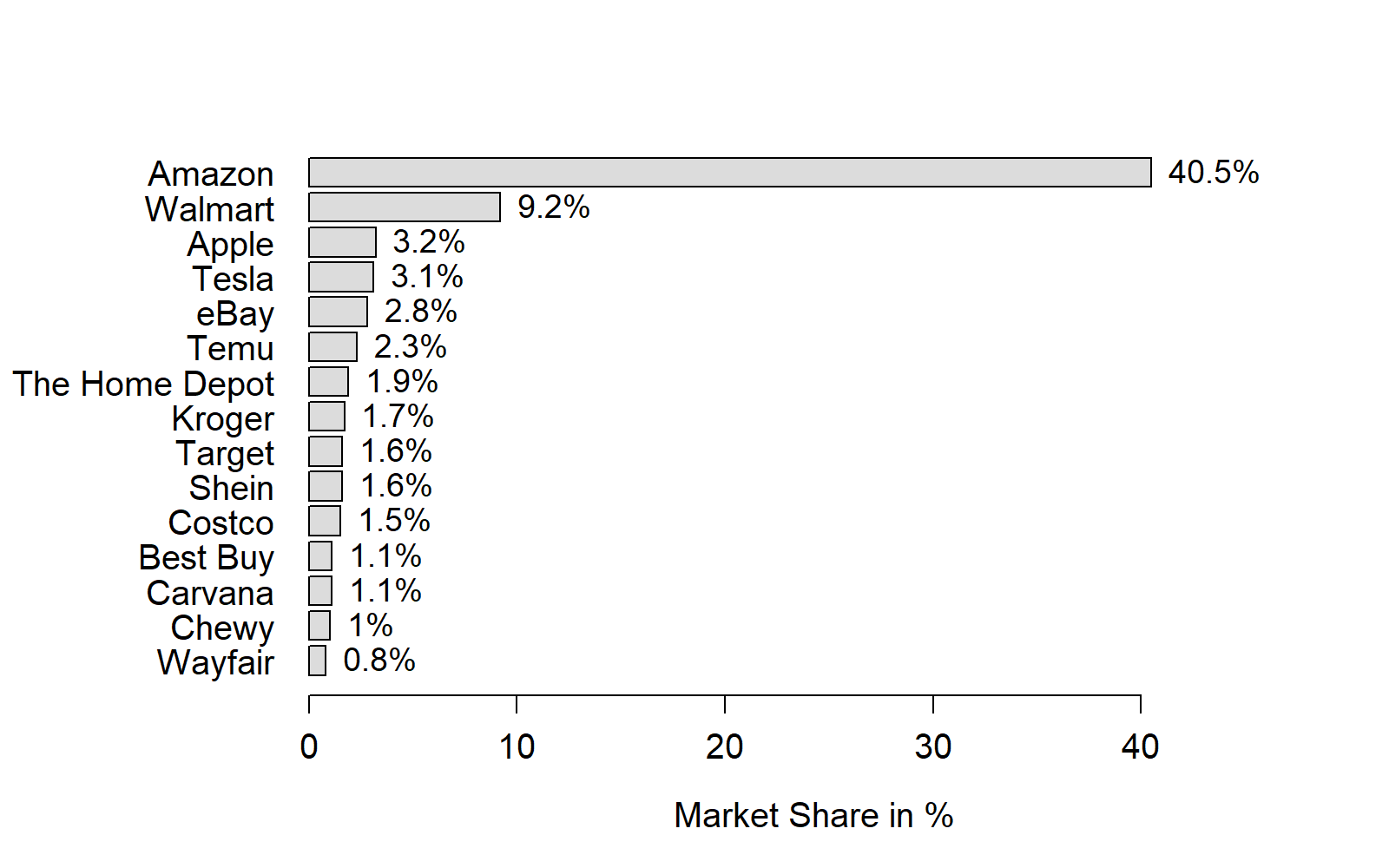
Online Market Share of US Retailers (2025) (Statista)
Caveats - what the model (and post) leaves out
This simple model focuses on an individual retailer without strategic interaction and treats competitors’ prices and access policies as fixed.
The model also simplifies consumer behavior. Customer acquisition and retention/defection rates are fixed. A consumer-focused decision model may provide additional features to consider in the agent adoption and usage process. Moreover, with different degrees of autonomy in agent behavior, an agent could recommend a competitor even if the retailer allows access.
Retailers have to think carefully about where shopping agents can make a meaningful difference for shoppers. For example, agents may provide more value when products are less standardized and rarer (e.g., collectibles) or when prices fluctuate more (e.g., flights), which increases search costs. The average shopping process for standardized products is already quite efficient and frictionless (e.g., reordering a toothbrush on Amazon, delivered via Prime the next day). In such settings, agents may be able to provide value by price comparisons and automatic refills.
The dashboard is a first attempt to provide decision support for retailers on adopting external agents, modeled as a trade-off between acquiring new and retaining existing customers, with a focus on the business value that can be captured in doing so.
The technical version of the paper will be posted on my GitHub soon.